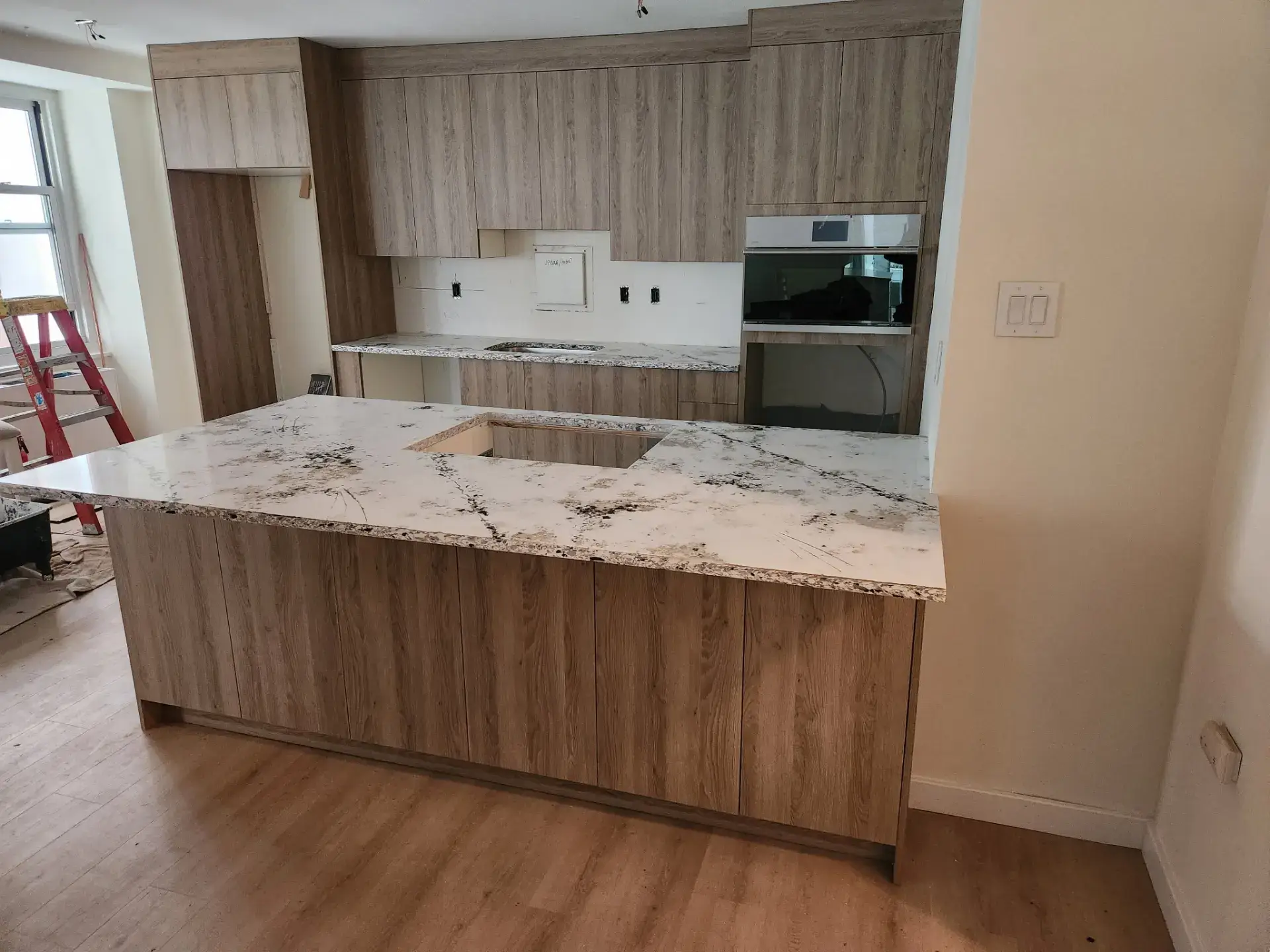
Plywood boxes are stiffer, hold screws better and shrug off a slow leak longer than particleboard, which is why they are the safer choice under a sink, in a laundry area or in a basement bar. Particleboard, when it is a dense industrial grade with a good laminate skin and solid joinery, builds a perfectly durable kitchen and is used in millions of them. The real answer is not one material for the whole job. It is knowing which boxes in your layout are exposed to water and abuse, and knowing how to open a door in a showroom and read the construction in about thirty seconds.
What the two materials actually are
People throw these terms around loosely, so it helps to be precise about what you are comparing.
Plywood
Plywood is thin layers of wood veneer glued in alternating grain directions. That cross grain lamination is where the strength comes from. It resists sagging across a span, it grips a screw in the edge rather than crumbling, and when it does get wet the layers may swell and delaminate but the panel usually keeps its shape long enough for you to find the leak. Cabinet plywood is typically half inch for sides and back, sometimes three quarter for the deck of a base cabinet, with a veneer or a printed melamine face on the interior.
Particleboard and furniture board
Particleboard is wood chips and resin pressed into a flat panel. The good stuff is dense, uniform and dead flat, which is why it is the standard substrate for laminate and thermofoil. It is dimensionally stable, it does not telegraph grain, and it will not warp the way a poorly dried solid panel can. Its weaknesses are edge screw holding and water. Once the resin bond in the edge gets saturated, the chips swell and never go back.
MDF, which is not the same thing
MDF is a finer fiber panel, heavier and smoother than particleboard. You will see it constantly in painted doors, center panels and end panels, and that is the right use for it. A painted five piece door with an MDF center panel is more stable than a solid wood one because the panel will not shrink in winter and open a hairline at the paint joint. MDF in a door is a feature, not a compromise. MDF in a sink base deck is a liability.
How to judge a box in a showroom
Displays are built to be looked at, so use them. When people come into our showroom on the Black Horse Pike we hand them the drawer and let them pull it apart. Here is what we look at, in order.
- Open a door and look at the edge of the shelf. A plywood shelf shows layers. Particleboard shows a speckled chip pattern. If the edge is banded, look at the underside of the shelf near the front where the band sometimes stops.
- Push on the middle of a side panel. Half inch plywood barely moves. A thin, hollow feeling side is telling you something about how the whole run will behave when it is screwed to a wall that is not perfectly flat.
- Look at the back. A full depth back panel captured in a groove is the difference between a cabinet that stays square and one that racks. Thin backs stapled on the outside with a mounting rail behind them are a cost decision and you should know it is there.
- Check the joints. Dowels and glue, or dado and rabbet joints, are what you want. Staples alone into an end grain edge are what fail first.
- Take the drawer out. Dovetailed solid wood drawer boxes with undermount soft close glides are now common across most price levels. Look at the bottom panel too. A captured bottom in a groove outperforms a bottom stapled underneath.
- Look inside for the finish. A sealed interior, whether it is a natural veneer with a clear coat or a good melamine, wipes clean and resists moisture at the surface. Raw, unsealed interiors are the ones that stain.
- Hang on a door. Not violently, just steady pressure. Six way adjustable hinges with a solid mounting plate stay aligned. This is where a strong side panel matters, because the hinge screws live in it.
Doing this across several of the lines we carry is the fastest education there is. We stock full door samples and cutaways for all seventeen of our cabinet brands, and comparing two boxes side by side tells you more than any spec sheet.
Where moisture actually matters
Water damage in kitchens is rarely a flood. It is a compression fitting that weeps for a year, a dishwasher gasket that drips, a spray hose connection that lets go behind the cabinet where nobody looks. That means the risk is concentrated in a few specific boxes.
- The sink base. This is the one cabinet where we push plywood every time, and if the line offers a factory sink base deck or a moisture resistant option, take it.
- The dishwasher end panel. The panel next to a dishwasher takes steam every cycle.
- Any base cabinet on an exterior or below grade wall where a slow condensation issue could sit unnoticed.
- Bathroom vanities. Small room, constant humidity, and a sink plumbing bay that takes up most of the box. We talk about this with almost every customer looking at bathroom vanities, and it is the single strongest argument for plywood in a bath.
- Laundry, mudroom and utility runs where a washer connection is nearby.
Two cheap habits protect either material. Put a drip tray or a peel and stick liner in the sink base so a slow leak sits on plastic instead of soaking a deck. And seal the sink cutout edge in the countertop, because that raw edge is often the first place water finds.
When particleboard is genuinely fine
Wall cabinets are the easy case. They carry dishes, not water, and a well built particleboard wall cabinet with a captured back and dowelled joints will outlast the finish on your walls. Pantries, upper runs, closet and office built ins, a bar cabinet away from a sink, a garage or basement cabinet that is staying dry, all of those are reasonable places to let the substrate be the substrate and spend the money elsewhere.
There is also a real argument for putting your money into things you touch instead of things you never see. Full extension undermount glides, soft close everywhere, a functional corner solution, a proper trash pullout and a layout that actually works are all felt daily. Nobody has ever run their hand along the inside of a wall cabinet and been disappointed by the substrate. If you are weighing tradeoffs on a kitchen cabinet order, that is usually where we steer the conversation.
The hybrid approach
Many lines let you specify plywood construction as an upgrade on the whole order, and some let you mix. The practical move for a lot of South Jersey kitchens is plywood everywhere in the base run and around wet zones, standard construction on the uppers. You get protection where the risk is and you do not pay for it where there is none.
How construction interacts with countertops
Heavy stone puts real load on the base cabinets. Quartz and granite need flat, square, properly shimmed boxes with sound decks, because the fabricator is templating to what is actually installed, not to what the drawing said. When the boxes are solid and level the seams sit tight and the overhangs behave. Our stone comes through our sister company in the same building, so the cabinet layout and the countertop template are working from the same set of measurements rather than two separate site visits.
Ask for the specs in writing
Any manufacturer worth carrying will state box material and thickness, back panel construction, joinery method, drawer box material and glide type. If a quote does not tell you those things, ask. It costs nothing and it is the only apples to apples way to compare two proposals that look similar on the surface.
Come see the difference in person. Stop by the showroom on the Black Horse Pike in Pleasantville, pull a few drawers apart and let us walk you through what each line is actually made of. Our design consultation is free and includes a layout, a 3D rendering and a written quote with no obligation, so get in touch whenever you are ready to start.
Leave a Reply